But the greatest change we need to make is from consumption to production, even if on a small scale, in our own gardens. If only 10% of us do this, there is enough for everyone. Hence the futility of revolutionaries who have no gardens, who depend upon the very system they attack, and who produce words and bullets, not food and shelter.
--Bill Mollison, Introduction to Permaculture
It seems a bit uppity to begin singing the praises of growing your own food when I have yet to actually grow anything, but our general detachment from the source of our food has bothered me for years. So many of us living in the developed world quite literally cannot feed ourselves. If all the Stop 'n Shops, Whole Foodses, and sketchy bodegas of the world suddenly disappeared, I might be able to survive, but more likely I'd just starve. This is something I am determined to change. It seems completely ridiculous to me that in regards to satisfying the most basic necessities of life I am essentially helpless.
Of course, I am a product of my world. There's no need to get upset about the fact that I would be hard pressed to survive without the public water system, because it's simply never come up. I'm not saying I want to get all "Man vs. Wild" on you, just that it's time to move in the direction of more sufficiency.
I recently saw an Exxon advert that featured Exxon engineers extolling the virtues of their new gas-extraction techniques. In the ad, one fellow states that "One way to put downward pressure on energy prices is to make more energy available." As in drill baby drill. This company and its employees were paying good money to put an ad on TV telling me that their solution to the energy crisis is to pour gasoline on a burning house. Beyond the obvious preposterousness of this concept (So you're addicted to crack, hmm, how about if we make crack cheaper? Yeah, that'll get you straightened right out), what most struck me about this ad was the focus on new technologies as a key to a brighter future. This fetishization of technology is something that I thought a lot about during my brief stint in the alternative-energy industry.
The fact is, we already have the technology to be constructing significantly more efficient buildings. Some of this technology isn't even "technology" at all: the orientation of a building, the thickness of its walls--these make huge differences in the indoor climate. Why are we building huge uninsulated boxes with no windows to simply then pump them with huge amounts of fossil fuels? The means already exist to reduce our energy consumption by an order of magnitude. Eat a little bit less meat, grow a little bit more food: you're making an impact.
So, well, none of us are likely to be building an Earthship anytime soon (though it sure would be sweet), but we can put a pot of tomatoes out on the scraggly side yard at our apartment. And maybe we can start composting and building up that scraggly side yard with yummy compost. And maybe in a year or two we can move somewhere a bit more rural and get some chickens. And a Skystream. And maybe a few dairy cows and some cheese making equipment. And an outdoor wood oven for the wholesale bread operation. And a hoop house for the microgreens...
Anybody want to come along?
Tuesday, March 31, 2009

Friday, March 27, 2009
In praise of pre-ferments
This is what your poolish looks like when it is ready to be used. It started as a gloppy batter, and over the course of 8-10 hours, rose to a puff and then just started to fall--you can see the creases in the face of the poolish that indicates it has just started falling. This is the time to pounce.
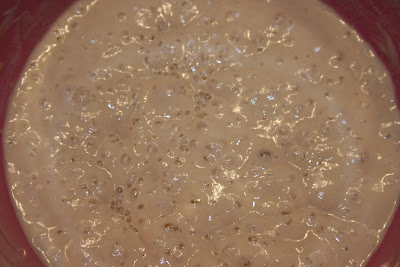
What's that? What's a poolish, you say? Why, I'm so glad you asked! I poolish is just one of my favorite pre-ferments. A pre-ferment, also referred to as a starter, is essentially a very short-term sourdough. Mixing a small portion of a bread recipe's ingredients and allowing them to ferment before actually starting the bread adds another layer of flavor to the finished product. There are many different types of pre-ferments, all variations on the same theme. A poolish is a goopy mixture of around 1/3 of the total amount of water and flour, with a small fraction of the yeast. A sponge is a batterlike substance incorporating 1/3 of the flour, half the yeast and all of the water. Then you've got your pate fermentee, aka scrap dough, which is pieces of fully kneaded, salted, and fermented dough. There are also bigas, the Italian version of a poolish, which are stiffer and more doughlike.
You can add a pre-fermentation step to any bread recipe. The easiest way is Rose Berenbaum's sponge method, as follows:
Mix together all of the water, 1/3 of the flour, and 1/2 of the yeast (and any fat and sweeteners), in a bowl with a whisk until well beaten. The mixture should be a medium-thick batter; scrape down the sides of the bowl. In another bowl, mix together the remaining flour and yeast, and gently scrape this mixture on top of the sponge, so the four-yeast mix covers the sponge like snow on a frozen lake. Cover the bowl with plastic wrap and let sit for at least one but up to six hours. You can also put it in the refrigerator overnight, but take it out one hour before mixing to allow it to come to room temperature. Then mix until it just comes together, autolyse, add the salt, knead, and off you go.

What's that? What's a poolish, you say? Why, I'm so glad you asked! I poolish is just one of my favorite pre-ferments. A pre-ferment, also referred to as a starter, is essentially a very short-term sourdough. Mixing a small portion of a bread recipe's ingredients and allowing them to ferment before actually starting the bread adds another layer of flavor to the finished product. There are many different types of pre-ferments, all variations on the same theme. A poolish is a goopy mixture of around 1/3 of the total amount of water and flour, with a small fraction of the yeast. A sponge is a batterlike substance incorporating 1/3 of the flour, half the yeast and all of the water. Then you've got your pate fermentee, aka scrap dough, which is pieces of fully kneaded, salted, and fermented dough. There are also bigas, the Italian version of a poolish, which are stiffer and more doughlike.
You can add a pre-fermentation step to any bread recipe. The easiest way is Rose Berenbaum's sponge method, as follows:
Mix together all of the water, 1/3 of the flour, and 1/2 of the yeast (and any fat and sweeteners), in a bowl with a whisk until well beaten. The mixture should be a medium-thick batter; scrape down the sides of the bowl. In another bowl, mix together the remaining flour and yeast, and gently scrape this mixture on top of the sponge, so the four-yeast mix covers the sponge like snow on a frozen lake. Cover the bowl with plastic wrap and let sit for at least one but up to six hours. You can also put it in the refrigerator overnight, but take it out one hour before mixing to allow it to come to room temperature. Then mix until it just comes together, autolyse, add the salt, knead, and off you go.
Wednesday, March 25, 2009
A few random comments
I lay in bed for a long time this morning, trying to suss out the difference between de rigeur and apropos. They both generally indicate correctness, but in what manner each? The best I could figure (aka convince myself of) was that when something is apropos it is fitting for an occasion--appropriate, if you will. Whereas de rigeur seems to me to be more strictly correct. For example:
"Jimmy, wearing a tuxedo to the prom would be apropos. Wearing trousers, however, is de rigeur."
Of course I could easily, and in less time than it took to type out these musings, look up the actual definitions of these words and be done with it. But I shan't! Nay!
*****************
The garden is already sprouting weeds, volunteer garlic from the neighboring plot, and strawberries. I spent some time in the morning sunshine finding rocks and logs to build out the perimeter of the plot. I'm picking up a truckload of composted horse manure on Sunday, and plan to pile it on as deeply as possible. Granted, I also plan to share the compost with whomever helps unload it, so I've a bit of an internal dialectic going between wanting a deep rich layer of compost on my plot and wanting help shoveling it out of the truck. Helpfully, I did buy myself a shovel. It's my first non-snow shovel, and I couldn't be more proud.
*****************
Last night I braised some pork spareribs Laura and I picked up at the Pawtucket (pronounced "p'tucket") farmers' market. They were so delicious I've decided to write down the recipe. As always, quantities are approximate.
Cider-Clementine Braised Spareribs
Serves 2
2 lb Pork spareribs (about six ribs), cut into two-rib segments
1 c Apple cider
3/4 c Clementine juice (from three clementines; feel free to use oranges)
1/2 c Soy sauce
1 Small onion, diced
1 1/2 tablespoon Asian chili-garlic sauce
1 thumb-sized knob of ginger, peeled and sliced into rounds
2 tablespoons sugar
1 tablespoon coffee syrup
Preheat the oven to 275. Heat a little oil in a Dutch oven over medium-high until shimmering. Pat the pork dry and season with salt and pepper. Brown pork, two minutes per side, in batches if necessary, and remove to a plate. Lower the heat to medium-low and saute the onion until translucent. Add the chili-garlic sauce and ginger, and continue to saute for another minute. Add the cider, juice, soy sauce, sugar, and coffee syrup and bring to a simmer. Return the pork to the pot, put the lid on, and place in the oven for 1 1/2 - 2 1/2 hours, turning every 45 minutes, until the bones slide out of the meat.
Remove the pot from the oven and remove the pork from the pot. At this point you can let everything cool and refrigerate for up to two days, and/or proceed. Skim the fat from the braising liquid and strain the remaining liquid. Return the braising liquid to the pot and bring to a boil. Reduce by 1/2 or until thickened. If necessary, make a slurry with 2 tablespoons cornstarch and water in a bowl and whisk in to the sauce to thicken (I had to). Season to taste.
Return pork to the pot with the sauce and toss to coat/warm. Garnish with sliced scallion.
"Jimmy, wearing a tuxedo to the prom would be apropos. Wearing trousers, however, is de rigeur."
Of course I could easily, and in less time than it took to type out these musings, look up the actual definitions of these words and be done with it. But I shan't! Nay!
*****************
The garden is already sprouting weeds, volunteer garlic from the neighboring plot, and strawberries. I spent some time in the morning sunshine finding rocks and logs to build out the perimeter of the plot. I'm picking up a truckload of composted horse manure on Sunday, and plan to pile it on as deeply as possible. Granted, I also plan to share the compost with whomever helps unload it, so I've a bit of an internal dialectic going between wanting a deep rich layer of compost on my plot and wanting help shoveling it out of the truck. Helpfully, I did buy myself a shovel. It's my first non-snow shovel, and I couldn't be more proud.
*****************
Last night I braised some pork spareribs Laura and I picked up at the Pawtucket (pronounced "p'tucket") farmers' market. They were so delicious I've decided to write down the recipe. As always, quantities are approximate.
Cider-Clementine Braised Spareribs
Serves 2
2 lb Pork spareribs (about six ribs), cut into two-rib segments
1 c Apple cider
3/4 c Clementine juice (from three clementines; feel free to use oranges)
1/2 c Soy sauce
1 Small onion, diced
1 1/2 tablespoon Asian chili-garlic sauce
1 thumb-sized knob of ginger, peeled and sliced into rounds
2 tablespoons sugar
1 tablespoon coffee syrup
Preheat the oven to 275. Heat a little oil in a Dutch oven over medium-high until shimmering. Pat the pork dry and season with salt and pepper. Brown pork, two minutes per side, in batches if necessary, and remove to a plate. Lower the heat to medium-low and saute the onion until translucent. Add the chili-garlic sauce and ginger, and continue to saute for another minute. Add the cider, juice, soy sauce, sugar, and coffee syrup and bring to a simmer. Return the pork to the pot, put the lid on, and place in the oven for 1 1/2 - 2 1/2 hours, turning every 45 minutes, until the bones slide out of the meat.
Remove the pot from the oven and remove the pork from the pot. At this point you can let everything cool and refrigerate for up to two days, and/or proceed. Skim the fat from the braising liquid and strain the remaining liquid. Return the braising liquid to the pot and bring to a boil. Reduce by 1/2 or until thickened. If necessary, make a slurry with 2 tablespoons cornstarch and water in a bowl and whisk in to the sauce to thicken (I had to). Season to taste.
Return pork to the pot with the sauce and toss to coat/warm. Garnish with sliced scallion.
Tuesday, March 24, 2009
Sowing seed

It's Spring, people. Spring is one of my very favorite things. Like, at all. It's definitely in the top three. And while it's been chilly outside these past few days, I can feel the wind has less bite. The sun is reasserting itself. 26 degrees feels more like 32, and 32 feels like 40. The trees are budding, the piles of dog poop on the street are starting to wilt. Spring!
I started my hot pepper plants today. On the advice of the nice lady at Pezza's garden center, and the seed pouch, I'm starting them indoors in adorable little seed starting pots. The pots are made of peat themselves, and can be placed directly in the ground when the seedlings are ready to be planted outdoors.
After reading way too much material about how to start seeds indoors, I became discouraged by the need to find a location in our apartment that is warm (the seed packet says "very warm"), sunny, and inaccessible to our pack of marauding felines. In the end, I chose very sunny and sorta warm. Once they sprout I'll move them to less-sunny, less-warm, but totally cat-free lodgings. Following the recommendation of a few sources, I covered the box with plastic wrap, which I hope will both help keep in moisture and generate some more warmth.
I bought a bag of organic seed starting mix, which smells wonderful, and piled it into the seed pots. Then I opened the bag of pepper seeds and, pouring them onto the counter, thought to myself, "Why, they look just like pepper seeds!"
After I finished with the sowing, I sat down to a breakfast of leftover homemade General Tso's Chicken and bit down on a hot pepper seed. I took the seed from my mouth and examined it. "Whoa," I thought, "I could totally, like, plant this."
I can only hope that this gardening experience will be full of such beautiful and humbling realizations.
Sunday, March 22, 2009
Chow Rhode Island, Episode 3: Coffee Milk
 Of the 27 states that list an Official State Beverage, 12 of them claim milk. Milk. I can see that in the big dairy states, but, well, I suppose I can't name all the big dairy states. A quick consult with my Secretary of Agriculture (aka Laura) was inconclusive. So I'll refrain from ragging on all you milk-guzzlin' states. Indiana, sensibly, selected water. Nebraska: Kool-Aid. I'm not even touching that one.
Rhode Island, my new home, chose to take on the traditional milk, but with a savage twist. My friends, I give you..

Subject: Coffee Milk
Aliases: None
Major Features: Coffee syrup, milk
Minor Features: None
At some point "back in the day" clever soda jerks began experimenting with different flavorings. Being a former soda jerk/bartender myself, I can empathize with the desire to try something new (beer frappes!). Eventually, sweet coffee syrup became fashionable, and after a few corporate mergers, the Autocrat brand emerged as the ne plus ultra of Rhode Island style coffee syrup. Despite living less than an hour from Rhode Island, I had never seen Autocrat, which also makes regular coffee, until I crossed the border. Maybe there are parts of Connecticut--or Attleboro--where you can get this stuff, but it seems to be pretty well contained to the Ocean State. Well, then, what is coffee syrup? Mostly, it's our good friend high fructose corn syrup.

Assessment: The recipe from the syrup bottle calls for 8 ounces of milk mixed with two tablespoons of syrup. Prepared thusly, coffee milk looks, smells, and tastes like a melted coffee frappe. There is a slight corn syrup mouth-coating finish. The coffee flavor is slight but good.
Conclusion: I'm not entirely sure when you would drink this. Personally, it just made me wish I were drinking an actual coffee frappe, or an actual cup of coffee. It definitely tastes coffee-y, and coffee milk would be an excellent gateway drug for coffee. If you're tired of your daily chocolate milk, or want your kids to get a taste for java, coffee milk is an excellent choice. I may explore other uses for the coffee syrup--or I might just throw it away. If I wanted to make coffee milk, I'd just brew some coffee and add it to a bunch of sugar and milk. But that's not the point of this exercise, now, is it?
Friday, March 20, 2009
Lappy 486
My new used computer arrived yesterday. It's a MacBook 2.4gHz, black. Blacker than the darkest night. Blacker than the black market, the black Visa, and Ultradark Material. I've named it Strindberg.
Setting up this computer is reminding me of how integral (pernicious?) computers can be to the home life. Currently I'm syncing my iPhone, calendar, contacts, all that stuff. Earlier I set up the external iTunes library, the MIDI controller, the wifi. Imported Firefox passwords. I still have to do the printer--but who prints these days anyway? It's remarkable to think about how much stuff we have that is now dependent on the computer. I don't listen to cd's anymore.
Telling Strindberg to find the iTunes library on my external hard drive has given me the opportunity to poke around my mp3 collection. There's the usual "oh I haven't listened to this in years" but also the occasional "oh lord no need to own this anymore". My favorite is discovering music I didn't know I owned. There's Ani DiFranco in here? And when the heck did I get six Tortoise albums? The Erykah Badu album I'd forgotten even existed ("Worldwide Underground"). An entire Tom Waits album that, because the tracks didn't have an album name listed, never appeared when I sorted his music (probably "Swordfishtrombones"). Harry Potter 1, 2, 3 & 6. A single INXS track ("Suicide Blonde"). What the heck is Hollertronix?
Now I'm excited to dig through my photograph library. What bizarreness will I find there? "Hey what's in this grainy old shot? Huh... looks like some sort of grassy knoll..."
Setting up this computer is reminding me of how integral (pernicious?) computers can be to the home life. Currently I'm syncing my iPhone, calendar, contacts, all that stuff. Earlier I set up the external iTunes library, the MIDI controller, the wifi. Imported Firefox passwords. I still have to do the printer--but who prints these days anyway? It's remarkable to think about how much stuff we have that is now dependent on the computer. I don't listen to cd's anymore.
Telling Strindberg to find the iTunes library on my external hard drive has given me the opportunity to poke around my mp3 collection. There's the usual "oh I haven't listened to this in years" but also the occasional "oh lord no need to own this anymore". My favorite is discovering music I didn't know I owned. There's Ani DiFranco in here? And when the heck did I get six Tortoise albums? The Erykah Badu album I'd forgotten even existed ("Worldwide Underground"). An entire Tom Waits album that, because the tracks didn't have an album name listed, never appeared when I sorted his music (probably "Swordfishtrombones"). Harry Potter 1, 2, 3 & 6. A single INXS track ("Suicide Blonde"). What the heck is Hollertronix?
Now I'm excited to dig through my photograph library. What bizarreness will I find there? "Hey what's in this grainy old shot? Huh... looks like some sort of grassy knoll..."
Wednesday, March 18, 2009

Subscribe to:
Posts (Atom)

